The Clock Of The Long Now
Most of us think of Now as the current moment, hour, day, week, or maybe month. What if you thought of right Now as extending to include 10000 years in the past to 10000 years in the future? From the dawn of agriculture to the distant unimaginable future?
How does taking such a long-term view change what you choose to work on, how you take responsibility, how you relate to what’s around you?
I enjoyed this work quite a lot. It directly inspired multiple questions for me, like How can I produce Long Content? and What are examples of Slow Science?. In my personal journal, I have made a list of things in my life that will survive for decades and that I can take more responsibility for over the long-term. I am brainstorming Long Art ideas and how I might work with the gardener in charge of my community to understand & improve the ecology of the garden. I have added many of the books mentioned in the text & from the Recommended Bibliography to my reading list.
I suspect the Long Now will be an extremely valuable ongoing lens for me.
A particularly useful framework from the book: there are six “pace layers” of civilization.
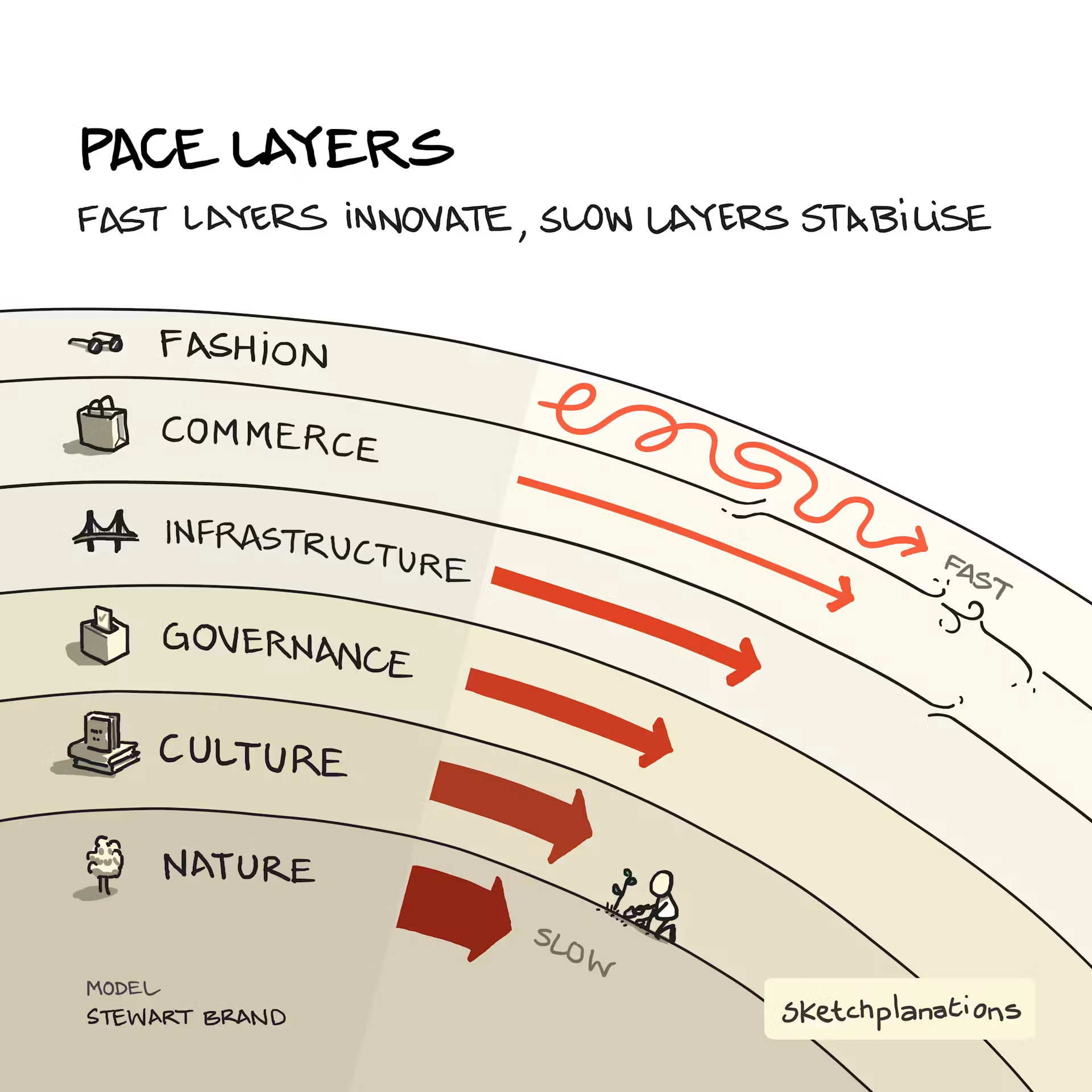
Many problems in the world can be understood as allowing one pace layer to dictate something that belongs to another layer – Nature being forced to move at the pace of Commerce often leads to environmental catastrophe & ecological collapse.
Other interesting ideas from the book:
- The longer a view you take, the more selfishness and altruism merge. If a company plans to be around for the truly long term, it’s in their best interest to educate the workers in their local community, preserve their local ecology, etc
- The “Big Here” as a natural adjunct to the Long Now – expanding where you feel part of, from your house/neighborhood, to your region/country, to the world
- Slow Science
- Applied History – Winston Churchill was a deep historian who applied the past in order to make decisions about & create the future
- Permanence is constant renewal. The outer part of Ise Shrine is ceremonially rebuilt every 20 years, for the last ~2000 years
- Physically written down words can be more permanent than digital artifacts. Digital media can physically degrade (disc rot), software is often brittle & quickly obsoleted
- It’s very difficult to know what future generations will value from today’s civilization. Example from book: monks spending 1000 years preserving Buddhist texts when carefully preserved feces would have been more informative
- Almost all environmentalists fought against the space program, arguing we need to solve Earth’s problems before exploring space. Unanticipated effect of space program: pictures of Earth from space kicked off the environmental movement
- “You can always improve things as long as you’re prepared to wait”
- Parallel: biological systems often use multiple timescales for stable identity + fast responsiveness (eg epigenetics, histone modifications & DNA methylation); multiple timescales and multi-level organization are how any complex system works
Provenance
Decided to read this book after reading https://gwern.net/about#long-content