What is the relationship between self-awareness and intelligence?
Lots of thoughts on this recently… brain dump time.
Reading Blindsight was my first exposure to the idea that self-awareness / consciousness / sentience could actually be an inhibitor on intelligence. Spending brain space on modeling & thinking about yourself may be worse than purely acting intelligently without any self-awareness. I don’t fully buy this idea, but it’s novel and worth thinking through.
Concurrently I have been reading Daoist ideas (the Zhuangzhi) and related articles – this wonderful post on Surrender and this article it links to about Returning to Nature. One of the core Daoist ideas, referenced in all of these texts, is that wu wei, translated poorly as “inaction,” though it seems to be more about letting your natural intelligence drive & aligning your actions to flow effortlessly with what is occurring. Return the body and mind to nature and see what happens. “Wisdom is timeliness.”
Anyways, the core thread here is – perhaps our natural intelligence (likely what we refer to as the unconscious mind) already knows what to do & our self-awareness can get in the way in many situations. That’s a bit stronger of a statement than I would make, as I think self-awareness can be quite valuable for humans specifically. I do buy the idea though from Blindsight that there are other pathways to intelligence.
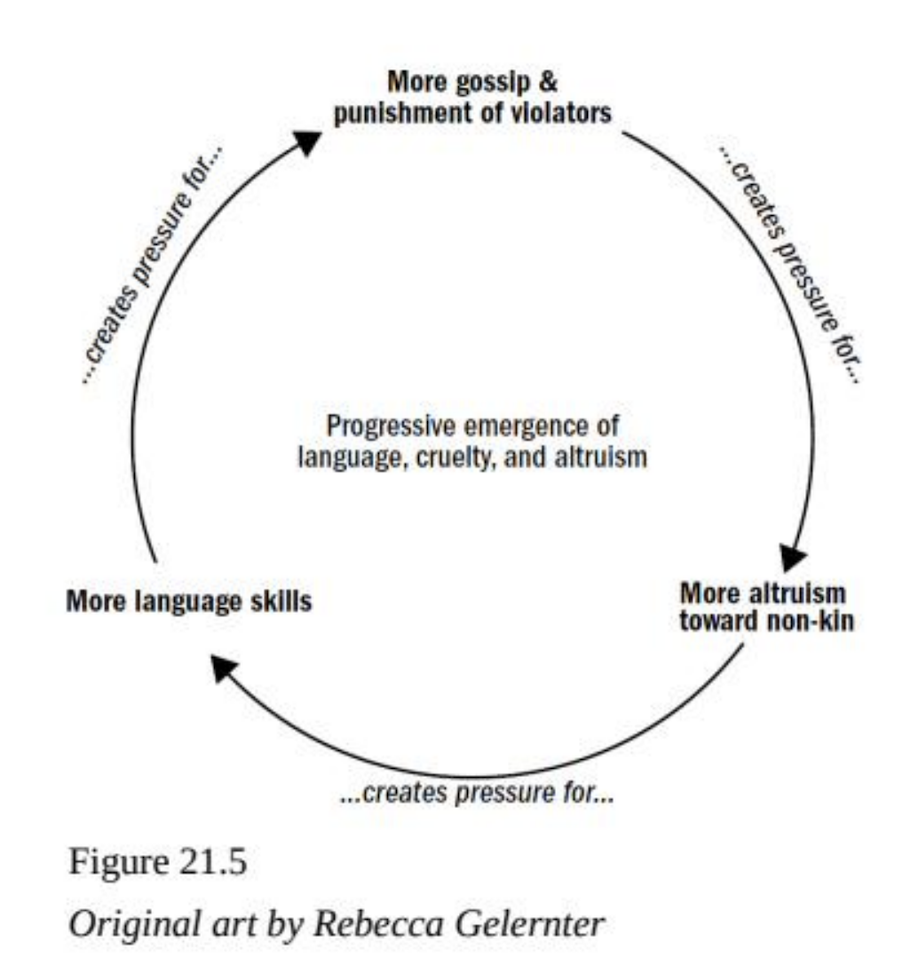
From A Brief History Of Intelligence it seems that one of the leading theories of why the human brain scaled up as much as it did is that our social dynamics got more and more complex, leading to greater returns on intelligence. More intelligence meant more complex social dynamics, creating a positive feedback loop:
Every roundabout of this cycle made our ancestors’ brains bigger and bigger. As social groups got bigger (powered by improved gossip, altruism, and punishment), it created more pressure for bigger brains to keep track of all the social relationships. As more ideas accumulated across generations, it created more pressure for bigger brains to increase the storage capacity of ideas that could be maintained within a generation. As the usefulness of inner simulations increased due to more reliable sharing of thoughts through language, it created more pressure for bigger brains to render more sophisticated inner simulations in the first place.
Does any of this require consciousness/self-awareness though? Ants have complex social dynamics without self-awareness (as far as we know). Is language the difference? LLMs have language but no self-awareness (as far as we know). So why do we have self-awareness? Presumably it’s expensive to run in the brain.
Actually hmm wasn’t there a section in Brief History on why self-awareness may have been necessary for future planning? The monkeys needing to imagine themselves getting hungry in the future to set up for fruits to ripen in the future? Or at least that was one hypothesis for how mentalizing / self-awareness appeared.