A Brief History of Intelligence
I learned a lot from this book. It covers a truly gigantic territory in evolutionary neuroscience, but is written extraordinarily clearly. It is one of my favorite nonfiction books. If you have any interest in evolution, neuroscience, or AI, I highly recommend this book.
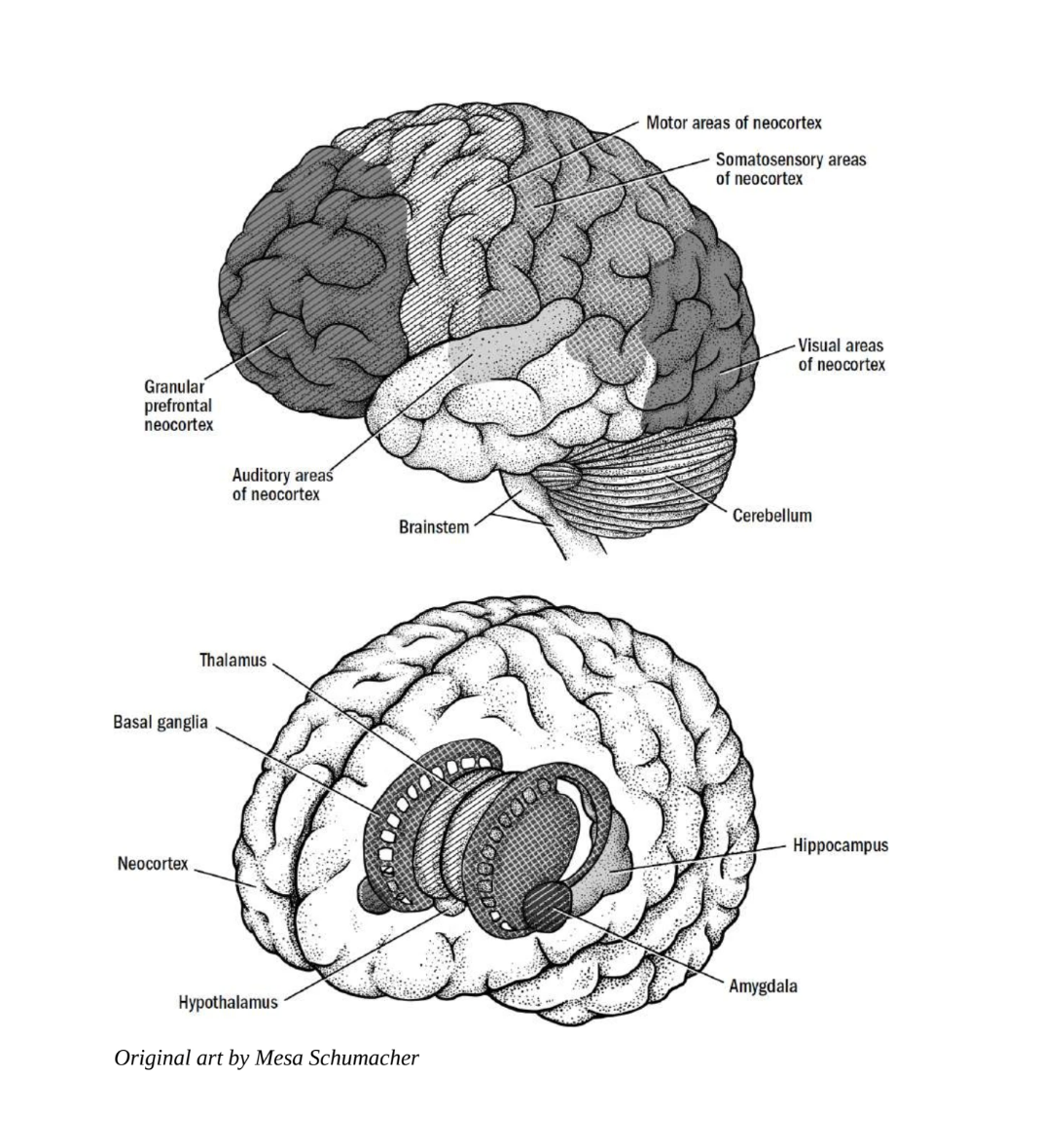
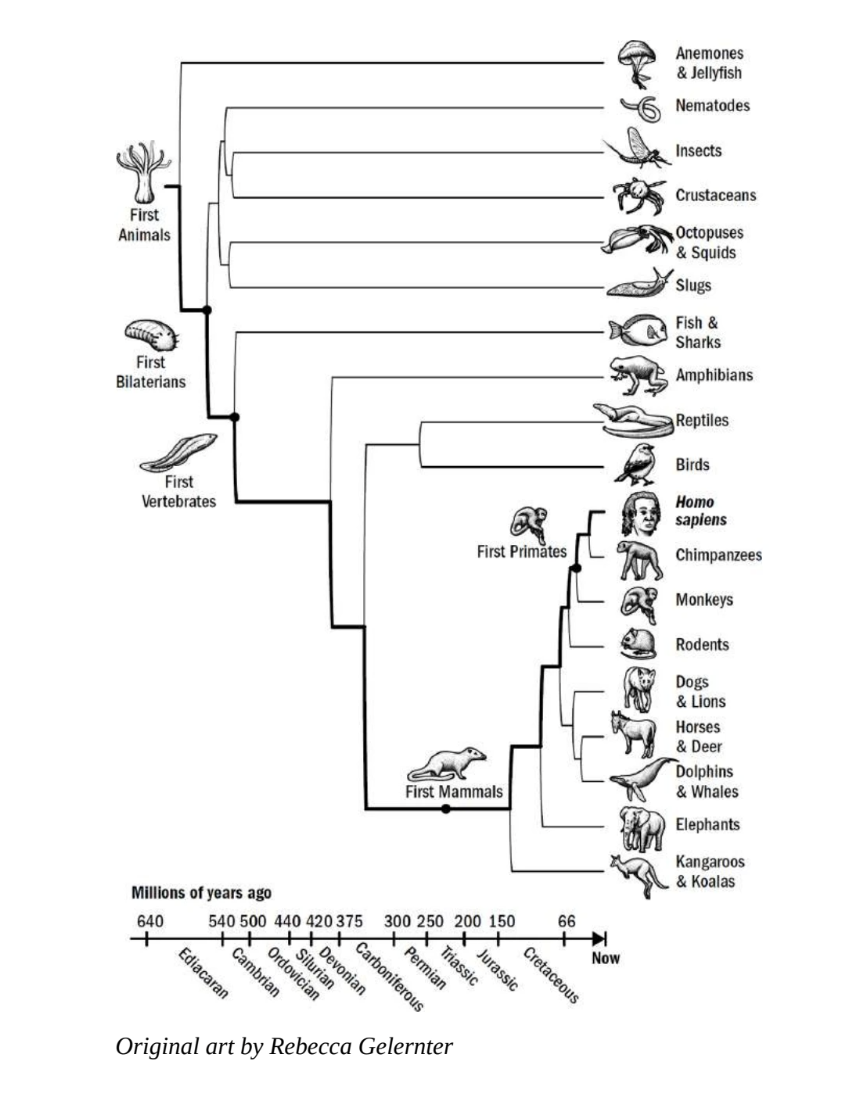
The two images above appear at the start of this book, and they make the thesis immediately clear: the best way to understand human intelligence is not to study the human brain directly, but to trace the evolutionary history of brains, because evolution starts simple and builds complexity over time, giving you an ordered step-by-step decomposition. The book is organized into five “breakthroughs”:
- Steering: bilaterians, ~600 million years ago
- Reinforcing: vertebrates, ~500 million years ago
- Simulating: mammals, ~200 million years ago
- Mentalizing: primates, ~15 million years ago
- Speaking: humans, ~100,000 years ago
Like anything in biology, there are always exceptions to such a clean story, but the narrative device of five breakthroughs is quite helpful as a broad sketch.
Things I was struck by in the book:
- Human brains are mostly just scaled up primate brains, with the possible exception of language
- Drove home the notion that language allows ideas to be transmitted from one brain to another, which increases sample efficiency of learning. Someone can just tell you to avoid this poisonous bush instead of you having to learn it yourself.
- Not in the book, but writing was the next technological step here, allowing ideas to be transmitted from brains in one generation to the next. IMO the “cultural evolution” this kicked off is the real key to the success of humans, as knowledge can compound across the species at a much faster rate than in genetic evolution
- Animals at every stage of evolution were fully functional in the real world. Even tiny brains never suffered from catastrophic forgetting. They were always able to do things like move, explore/exploit, have some level of contextual memory, do associative learning. Thus, hardware and software1 co-evolved over time
- Reuse & recombination of existing machinery in evolution is rampant. Repurposing old machinery, bolting new learning systems on top of old more-hardwired systems, etc is the name of the game
- History of AI and neuroscience is actually quite divergent. Neuroscience contributed the idea of the “neuron” to AI back in the mid-1900s and inspired CNNs, but it doesn’t seem to have contributed any other major ideas. In fact, AI actually came up with TD learning (the basis of RL) first and evidence was later found of it in the brain! Will neuroscience help us build AI or will it be AI that ultimately helps us understand the brain?
- A speculation in the book – we imagine the mind of others (theory of mind) the same way we imagine the mind of our own future self (anticipating future needs). This is supported by our bias of projecting our own experience onto others. Thirsty people become biased to predict others must also be thirsty. This makes the belief “my experience is a reasonable reference” from belief-consistent information processing appear like an inbuilt default, rather than a ‘belief’ per se. I wonder if confirmation bias might also be due to mental abilities being similarly repurposed/overloaded?
Provenance
Forget exactly where I first heard about this book, but possibly from this podcast episode which I really enjoyed
Footnotes
-
I don’t actually think there is a meaningful distinction between hardware & software in the brain (which this point kind of proves), but it’s a useful abstraction/analogy ↩